

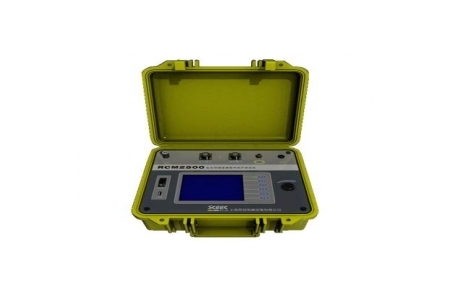
During on-site selection, the differences between very low frequency withstand voltage testing and power frequency or DC withstand voltage testing directly affect operation and maintenance efficiency. Power frequency test equipment is large and heavy, making it inconvenient to transport at substation sites; although DC withstand voltage equipment is lightweight, the DC electric field can easily cause internal insulation defects to be missed, resulting in "false pass" phenomena. KD-120 uses a 0.1Hz very low frequency AC output, periodically changing the direction of the electric field, which can effectively expose defects such as mechanical damage and water tree aging inside the insulation. At the same time, the equipment weight and volume are significantly reduced compared with power frequency solutions, making it suitable for on-site operation and maintenance.
The device has an output voltage of 0~80kV (peak), a frequency of 0.1Hz, a load capacity of 1.1μF, a voltmeter accuracy of class 1.5, and overcurrent and overvoltage protection functions. Compared with power frequency test equipment of the same capacity, the excitation current required at 0.1Hz is small, and the power supply capacity can be reduced to about 1/500 of that at power frequency. On site, only ordinary mains power is needed to meet the power supply requirements. During selection, the load matching should be calculated according to the capacitance of the cable or equipment under test. The 1.1μF load capacity can cover the withstand voltage requirements of most medium- and low-voltage XLPE cables.
After the test is completed, the discharge rod must first be used for sufficient grounding discharge, and the wiring can only be removed after confirming that there is no residual voltage. Operation and maintenance personnel should strictly follow the discharge procedure to avoid safety risks caused by residual charge. The device has overcurrent and overvoltage protection and automatically cuts off the output in abnormal conditions, but the discharge status still needs to be manually confirmed.

