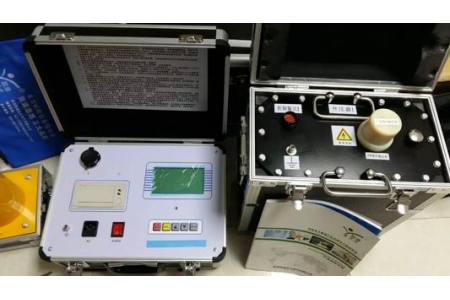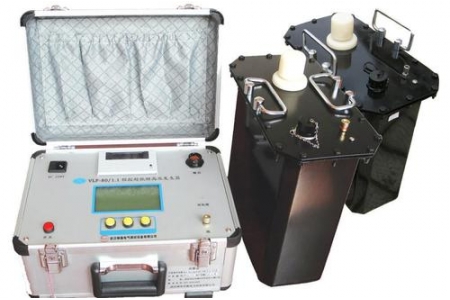
The Very Low Frequency (VLF) withstand voltage test is an important alternative to the power frequency withstand voltage test, mainly used to verify the insulation withstand capability of large-capacity capacitive electrical equipment (such as power cables, large generators, etc.). It applies an AC high voltage at an extremely low frequency (usually 0.1Hz and below) to equivalently assess the insulation strength of the equipment.
Core Working Principle
Traditional power frequency (50Hz) withstand voltage tests on equipment with large capacitance, such as cables, generate extremely large capacitive currents, leading to test transformers or resonant transformers that are bulky, expensive, and extremely difficult to transport on site.
The core principle of the VLF withstand voltage test lies in "frequency reduction and capacity reduction":
Reducing capacitive current: By significantly lowering the test frequency (e.g., to 0.1Hz), the capacitive reactance of the cable increases substantially, thereby significantly reducing the charging current.
Reducing equipment capacity: According to the capacitive current formula, lowering the frequency greatly reduces the capacity requirements of the test power supply. Theory and practice have proven that the theoretical capacity of VLF test equipment is only one five-hundredth of that of power frequency equipment, thus achieving lightweight and portable equipment.
Equivalence verification: Years of theory and practice at home and abroad have proven that the 0.1Hz VLF withstand voltage test is equivalent to the power frequency withstand voltage test in assessing insulation strength.
Main Advantages and Technical Features
Portable and efficient equipment: Using modern digital frequency conversion technology and microcomputer control systems, the equipment is small in size and light in weight, making it very suitable for frequent relocation at substations, cable trenches, and outdoor construction sites.
Safe and reliable testing: Compared to DC withstand voltage tests, VLF AC withstand voltage is closer to the actual AC electric field conditions of cable operation, effectively avoiding the space charge accumulation problem caused by DC voltage and reducing insulation damage to cross-linked polyethylene (XLPE) cables.
Intelligent automated operation: Features automatic voltage boosting, automatic timing, automatic voltage reduction, and automatic discharge, supporting test report printing and data storage, greatly simplifying the test procedure.
Comprehensive safety protection: Built-in high and low voltage dual overcurrent protection, overvoltage protection, and flashover protection mechanisms. In the event of an abnormality, the protection action time is typically less than 20 milliseconds, ensuring human and machine safety.
Key Technical Parameter Reference
Specific parameters may vary by model; the following are typical industry technical indicator ranges:
Table
Download as table
Export as image
Parameter Item Typical Value/Range
Output Frequency 0.1Hz, 0.05Hz, 0.02Hz (adjustable)
Output Voltage 30kV, 50kV, 80kV, 90kV (multiple selectable levels)
Measurement Accuracy ±(3% full scale + 0.5kV) or ≤±3%
Waveform Distortion ≤ 5%
Load Capacity Up to 1.1μF at 0.1Hz
Core Application Scenarios
The VLF withstand voltage test is widely used in the commissioning tests and preventive tests of the following power equipment:
Power cable testing: Especially for 10kV and 35kV cross-linked polyethylene (XLPE) insulated power cables, used to accurately identify insulation water trees, aging, moisture, and local defects.
Large generator testing: Used for insulation withstand voltage testing of stator windings in turbine generators and hydro generators, replacing bulky power frequency test transformers.
High-voltage capacitors and GIS equipment: AC withstand voltage testing for shunt capacitors, coupling capacitors, and GIS insulation components.
Main Standards Followed
DL/T 849.4-2004 "General Technical Conditions for Special Testing Instruments for Power Equipment - Part 4: General Technical Conditions for Very Low Frequency High Voltage Generators" (core domestic industry standard).
IEEE 400.2 "IEEE Guide for Field Testing of Shielded Power Cable Systems Using Very Low Frequency (VLF)" (international testing guide).
Mainstream Brand Reference
Table
Download as table
Export as image
Brand Type Representative Manufacturers Brief Description
Domestic Main Manufacturers Wuhan Huayi Electric Power, Wuhan Qianxu Electric Power, Wuhan Guodian Xigao Electric, etc. Relying on the technical accumulation of Wuhan High Voltage Research Institute, they offer a rich product line and high cost performance. They have significant advantages in localized services, on-site portability, and full-specification customization, and are preferred suppliers for State Grid/China Southern Power Grid.
When selecting equipment, it is recommended to focus on the instrument's output frequency stability, load capacity (capacitance), waveform distortion, and the response time of multiple protection mechanisms, and ensure that the equipment has a third-party verification certificate from a provincial-level or higher metrology institute or electric power research institute.