

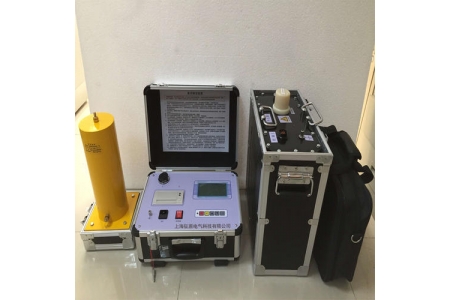
In the handover and preventive tests of 10kV or 35kV XLPE cables, power-frequency withstand voltage equipment is large and heavy, making it difficult to meet the testing needs of long cables on site. The very low frequency withstand voltage test device adopts a 0.1Hz frequency output, and its volume is about 1/500 of that of power-frequency equipment, making it easy to carry to the site while maintaining good defect detection capability equivalent to power frequency, making it a solution worth considering during design selection.
The JXVLF-80 very low frequency withstand voltage test device consists of a program-controlled very low frequency high-voltage generator, dedicated flexible connecting cables, and a discharge rod. Main technical parameters: output voltage 0–80kV (peak), frequency 0.1Hz, load capacity 1.1μF, voltmeter accuracy class 1.5, with overcurrent and overvoltage protection functions. The device adopts digital frequency synthesis technology, with stable output waveform, and is suitable for insulation withstand voltage tests of capacitive test samples such as XLPE cables and generators.
This device is suitable for handover acceptance, preventive testing, and generator insulation detection of power cables. Before the test, all connections to the test sample must be disconnected, and the insulation resistance must be measured with a 5000V or 10000V megohmmeter; the test can be carried out only after it passes. When wiring, the high-voltage end is connected to the conductor of the phase under test, and the non-test phases and metal shield are reliably grounded. After parameter setting, increase the voltage and closely monitor the high-voltage circuit. After raising to the test voltage, start timing; when the time is up, it stops automatically. After reducing the voltage to zero, cut off the power supply, fully discharge, and re-measure the insulation resistance. If there is no destructive discharge during the withstand voltage process and no abnormal heating at the intermediate joints, it is judged as qualified.
Compared with power-frequency withstand voltage, very low frequency equipment is smaller and lighter, suitable for on-site testing of long cables; compared with DC withstand voltage, very low frequency does not produce space charge accumulation damage, and the electric field distribution is closer to the operating state. According to standards such as GB 50150-2016 and DL/T 596-2021, very low frequency withstand voltage can be used as an alternative when power-frequency conditions are not met, and has good defect detection effect on XLPE cables.
During design selection, an appropriate model should be selected according to the capacitance of the test sample and the test voltage to ensure that the load capacity meets the requirements. During use, strictly implement the procedures of power outage, voltage verification, and installation of grounding wires, and set up fences and warning signs in the test area. Calibrate the equipment once a year, and the voltmeter accuracy should not be lower than class 1.5. If abnormalities occur due to humidity or contamination, clean and dry it before retesting.

