Very Low Frequency Withstand Test
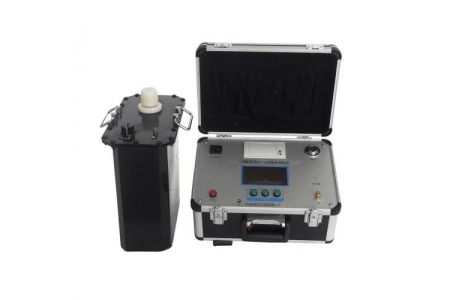
The Very Low Frequency Withstand Test (VLF) is a test method that uses 0.01Hz~0.1Hz very low frequency AC high voltage to assess the insulation withstand voltage of capacitive electrical equipment such as power cables, large motors, and capacitors. It is essentially an alternative to the power frequency withstand test. Under the premise of ensuring equivalent insulation stress, it greatly reduces the capacity requirements for test equipment, and is particularly suitable for on-site withstand tests of long-distance cables.
Working Principle
Cables are large-capacitance equipment. At power frequency (50Hz), their capacitive reactance is very small, and a large charging current will be generated during the withstand test, placing extremely high requirements on the test power supply capacity. The core idea of the very low frequency test is "reduce frequency to reduce capacity":
The 50Hz power frequency AC voltage is rectified and filtered into DC, and then inverted into a 0.1Hz (or 0.05Hz, 0.02Hz) AC high-voltage sine wave. When the frequency is reduced to 1/500 of the power frequency, the capacitive reactance increases correspondingly to 500 times that of the power frequency. Theoretically, the required test power supply capacity is reduced to 1/500 of that for power frequency withstand testing, thereby greatly reducing the size and weight of the equipment and making it easy to carry on site.
Core Advantages
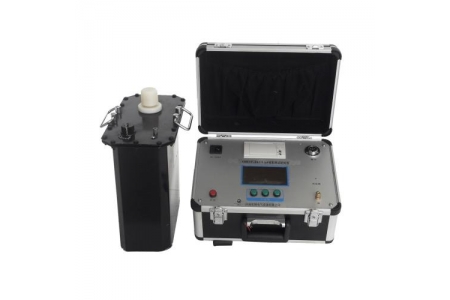
Lightweight and portable equipment: The theoretical capacity is only 1/500 of that of power frequency testing. The equipment volume and weight are far smaller than traditional power frequency withstand voltage devices, making it suitable for field and substation on-site operations
Less insulation damage: The AC voltage periodically changes the direction of the electric field, and will not generate harmful polarization charges entering the dielectric like DC withstand voltage, resulting in less cumulative damage to the insulation
Good detection effect: The AC electric field more easily exposes defects such as water tree aging and mechanical damage inside the insulation, avoiding the "false pass" phenomenon that may occur in DC withstand voltage testing
Good equivalence: Scientific theory and practice have proved that the very low frequency withstand test has good equivalence with the power frequency withstand test
High degree of automation: Fully electronic design, with automatic voltage rise, stabilization, voltage reduction, and timing throughout the whole process, and built-in multiple protections such as overvoltage, overcurrent, and breakdown
Table
Download as table
Export as image
Parameter Typical Value
Test frequency 0.1Hz / 0.05Hz / 0.02Hz
Output voltage 0~90kV (single-stage direct output)
Measurement accuracy ±(3% full scale + 0.5kV)
Load capacity 1.1μF at 0.1Hz, 2.2μF at 0.05Hz
Operating temperature -10℃~+40℃
Humidity ≤85%RH
Test Standards and Voltage Requirements
The very low frequency withstand test is mainly carried out according to the following standards:
Handover test (according to GB 50150-2016):
Table
Download as table
Export as image
Cable voltage level Test voltage Duration
8.7/10kV (U₀/U) 3U₀ = 26.1kV 60min
26/35kV (U₀/U) 3U₀ = 78kV 60min
Preventive test (differences exist among different standards):
Table
Download as table
Export as image
Standard source Test voltage Duration
DL/T 596-2021 2.5U₀ 15~60min
North China Power Grid Regulations 2.1U₀ 5min
Jiangsu Electric Power Company Regulations 3U₀ 20min
You are located in Yangzhou, Jiangsu. If preventive testing is carried out locally, you may refer to the requirements of 3U₀ and 20min pressurization in the "Jiangsu Electric Power Company Preventive Test Regulations for Power Equipment".
Scope of Application
Mainly applicable to: 35kV and below cross-linked polyethylene (XLPE) insulated power cables and their accessories
Can also be used for: large high-voltage rotating machines, power capacitors, PE/EPR/RL/PILC cables
Not applicable to: cables of 110kV and above voltage levels (such cables should use the variable frequency series resonance method)
Standard Test Procedure
Pre-test preparation: Disconnect the external connections of the cable, use a 5000V megohmmeter to measure and record the insulation resistance, and set up safety fences and warning signs
Wiring: Connect the high-voltage end to the conductor of the phase under test, and reliably ground the non-tested phases and the metal shield/armor
Parameter setting: Set test voltage, test time, and other parameters on the touch screen
Voltage rise: Start the device and automatically raise the voltage uniformly to the target voltage. During the voltage rise process, monitor the high-voltage circuit and check for abnormal sounds
Withstand voltage maintenance: Maintain the specified time and monitor the stability of voltage and current
Voltage reduction and discharge: After automatically reducing the voltage to zero, cut off the power supply, and use a discharge rod to fully discharge the test object
Retest: After the test, retest the insulation resistance and compare and analyze it with the data before the test
Pass judgment: No destructive discharge (no breakdown) throughout the entire withstand voltage process. No upper limit for leakage current is specified.
Comparison with Series Resonance Withstand Voltage
Table
Download as table
Export as image
Comparison item Very low frequency (VLF) Variable frequency series resonance
Principle Reduce frequency to reduce capacity Frequency matching resonance voltage rise
Applicable voltage level 35kV and below All voltage levels
Equipment portability Small size and light weight, suitable for rapid inspection Relatively larger, suitable for fixed locations or large projects
On-site applicability Obvious advantages for on-site testing of long cables The only choice for 110kV and above cables
Equivalence Good equivalence with power frequency Closer to real operating conditions
For 35kV and below cables, either can be selected, and very low frequency equipment is more portable; for 110kV and above cables, series resonance is the only choice.
GB 50150-2016: Standard for Handover Test of Electrical Equipment in Electrical Installation Engineering
DL/T 596-2021: Preventive Test Regulations for Power Equipment
DL/T 849.4-2004: General Technical Conditions for Very Low Frequency High Voltage Generators
DL/T 474.4-2018: Implementation Guidelines for On-site Insulation Tests - AC Withstand Voltage Test
GB/T 3048.8: Test Methods for Electrical Properties of Wires and Cables - AC Voltage Test