Very Low Frequency Withstand Voltage Test
Very Low Frequency (VLF) Withstand Voltage Test is a test method that uses AC high voltage at 0.1Hz or lower frequency to assess the insulation strength of power equipment. It is mainly used for acceptance tests and preventive tests of cross-linked polyethylene (XLPE) insulated power cables at 35kV and below, large high-voltage rotating machines, power capacitors, and other equipment.
Working Principle
The core principle of the VLF withstand voltage test is "frequency reduction and capacity reduction":
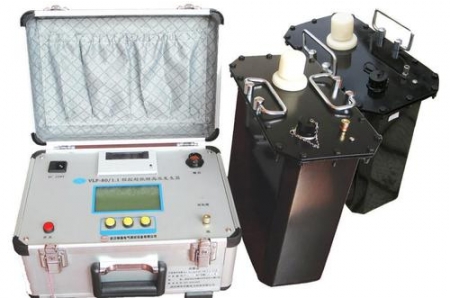
According to the capacitive reactance formula Xc = 1/(2πfC), when the frequency drops from 50Hz to 0.1Hz, the capacitive reactance of the test object increases to 500 times that of the power frequency. Correspondingly, the charging current and power supply capacity required for the test theoretically reduce to 1/500 of the power frequency withstand voltage test. This allows the test equipment to be extremely lightweight, and a single person can carry it to work in confined spaces such as fields, tunnels, and cable trenches.
The specific implementation path is: the 50Hz power frequency AC voltage is rectified and filtered into DC, then inverted into 1kHz AC voltage through an inverter, and finally amplitude-modulated by a 0.1Hz sine wave oscillator to output a 0.1Hz high-voltage sine wave applied to the test object.
In terms of insulation assessment equivalence, both theory and practice have proven that the electric field stress and aging assessment effects of 0.1Hz VLF AC voltage on cable insulation are well equivalent to those of 50Hz power frequency voltage. At the same time, AC voltage can periodically change the direction of the electric field, making it easier to expose defects such as water tree aging and mechanical damage inside the insulation, avoiding the "false pass" phenomenon that may occur in DC withstand voltage tests.
Comparison with Other Withstand Voltage Test Methods
Table
Download as Table
Export as Image
Comparison Item VLF (0.1Hz) Variable Frequency Series Resonance (30~300Hz) Power Frequency Withstand Voltage (50Hz)
Equipment Weight <20kg, portable by one person Modular, heavier Heaviest, difficult to transport
Power Supply Requirement 220V civil mains power is sufficient Usually requires 380V industrial power Large-capacity power frequency power supply
Applicable Voltage Level 35kV and below Full coverage from 10kV to 500kV Small-capacity equipment
Applicable Scenarios Distribution networks, confined spaces, fields Long cables, GIS, high-voltage equipment Laboratories, fixed locations
Insulation Damage Minimal, no space charge accumulation Minimal, automatic detuning upon breakdown Relatively small
Equipment Cost Low Relatively high Medium
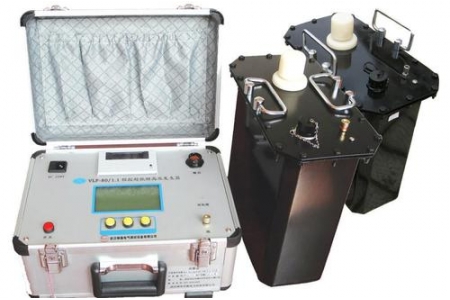
Extreme portability: controller about 4kg, boost body 25~50kg, split design, portable in a single backpack, suitable for confined spaces such as cable tunnels, underground wells, and trenches
Low power supply threshold: only requires AC 220V civil mains power, no industrial power supply needed, can operate in field scenarios without power sources
Insulation friendly: AC voltage does not produce space charge accumulation, no cumulative damage to XLPE cable insulation, much less destructive than DC withstand voltage
Good equivalence: good insulation assessment equivalence with power frequency withstand voltage tests
Full automation: adopts digital frequency conversion technology and microcomputer control, fully automatic test process, equipped with LCD touch screen display, automatic storage and printing
Comprehensive protection: equipped with multiple protection mechanisms such as overvoltage, overcurrent, and zero-position protection, with action time ≤20ms
Multiple frequency options: supports 0.1Hz, 0.05Hz, 0.02Hz and other multi-gear frequency output
📐 Test Standards and Parameters
Main reference standards:
GB 50150-2016 "Standard for Acceptance Test of Electrical Equipment Installation Engineering"
DL/T 596-2021 "Regulations for Preventive Tests of Power Equipment"
DL/T 849.4-2004 "General Technical Conditions for Very Low Frequency High Voltage Generators"
"Test Method for Very Low Frequency (0.1Hz) Withstand Voltage of Cross-linked Polyethylene Insulated Power Cables at 35kV and Below"
Acceptance test parameters (according to GB 50150-2016):
Test voltage: 3U₀ (RMS value), where U₀ is the rated working voltage of the cable conductor to ground
Duration: 60min
Example: 8.7/10kV cable → test voltage 26.1kV; 26/35kV cable → test voltage 78kV
Preventive test parameters (differences exist among different standards):
DL/T 596-2021: 2.5U₀, duration 15~60min
Jiangsu Provincial Electric Power Company regulations: 3U₀, pressurization for 20min
Acceptance criteria:
No destructive discharge (no breakdown) during the entire withstand voltage process is considered qualified
No upper limit for leakage current is specified
Before and after the test, use a 5000V megohmmeter to measure insulation resistance and compare and analyze
Power cables: acceptance tests and preventive tests for XLPE insulated power cables at 35kV and below (most important application)
Large high-voltage rotating machines: AC withstand voltage tests for generator stator windings
Power capacitors: insulation strength assessment of high-voltage capacitors
Cable accessories: insulation testing of cable terminations and intermediate joints
Distribution network operation and maintenance: daily inspection and condition assessment of distribution network cables
Key parameters:
Output voltage range: select according to the voltage level of the cable under test, ensuring the test voltage requirement of 3U₀ is met
Output frequency: preferably supports 0.1Hz, 0.05Hz, 0.02Hz multi-gear adjustable
Waveform quality: voltage waveform distortion rate should be <5%, peak instability ≤1%
Protection functions: confirm multiple protections such as overvoltage, overcurrent, and zero-position protection
Human-machine interaction: preferably 7-inch touch screen, automatic storage and printing, Chinese display
Environmental adaptability: working temperature -10℃~+40℃, humidity ≤85%RH
Selection suggestions:
Daily inspection of 10kV/35kV cables in distribution networks → portable VLF (lightweight, low cost)
Factory inspection by cable manufacturers → high-precision type (good waveform quality, traceable data)
High-voltage cables at 110kV and above → VLF not applicable, should choose variable frequency series resonance device
Preparation before test: disconnect external connections, fully discharge and ground, measure insulation resistance with a 5000V megohmmeter, set up safety fences and warning signs
Wiring: connect the high-voltage end to the phase conductor under test, reliably ground the non-tested phases and metal shield/armor, and reliably ground the instrument grounding terminal
Voltage increase: start the equipment, slowly increase voltage from a value 40% below the specified voltage, after exceeding 75%, increase at a rate of 2% per second to the target value
Withstand voltage: maintain the specified time, monitor voltage and current stability, listen for any abnormal discharge sounds
End: reduce voltage to zero, cut off power, use a discharge rod to fully discharge, then hang the grounding wire
Retest: measure insulation resistance again and compare and analyze with pre-test data