

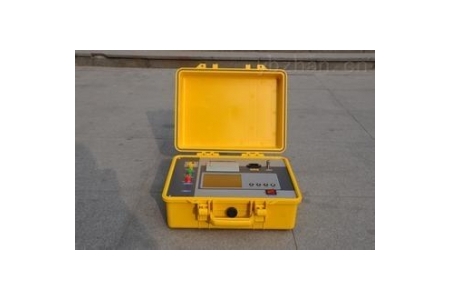
During the design and selection stage, problems such as poor test repeatability, ambiguous diagnostic conclusions, and inability to compare data from different manufacturers are often encountered. The ZNRB-60 Transformer Winding Deformation Tester is based on the Frequency Response Analysis (FRA) method and provides quantifiable criteria and a stable hardware platform to address the above problems.
Frequency range: 1kHz–2MHz (optional 20Hz–10MHz broadband configuration); dynamic range: -120dB; scanning mode: linear/logarithmic selectable; impedance method optional: supports short-circuit impedance measurement, complementary to the frequency response method. The equipment is designed in accordance with DL/T 911-2016 "Frequency Response Analysis Method for Power Transformer Winding Deformation" and provides two criteria: longitudinal correlation coefficient and transverse correlation coefficient.
The software automatically calculates correlation coefficients: normal (longitudinal >0.99, transverse >0.98), slight deformation (longitudinal 0.97–0.99), moderate deformation (0.95–0.97), severe deformation (<0.95). Transverse comparison is suitable for relative judgment among multiple transformers of the same model. During testing, parameters such as ambient temperature and humidity are automatically saved to provide a traceable basis for subsequent diagnosis.
For county-level distribution network operation and maintenance, a basic frequency response method portable configuration can be selected; for 110kV-220kV substation pre-tests, FRA + impedance dual method is recommended; for inspection of box-type transformers at new energy stations, a portable type (≤7kg) with IP54 protection and anti-interference design is preferable; for factory quality inspection at transformer manufacturers, a model with a higher degree of automation can be selected, supporting one-click report generation.
It is necessary to clarify the voltage level, whether dual-mode impedance is required, and whether portability is required. Broadband range and high-precision template library are suitable for provincial electric power research institutes and large power generation groups. For field use, priority should be given to software operation convenience and automatic recording of environmental parameters.

